
Replacing an Unknown Compressor
Does this sound familiar?
You are called out to service a walk-in cooler. It is loaded with product and the box temperature is at 60˚F. The customer is concerned about the product and needs the cooler repaired as soon as possible. You discover the compressor is defective, but notice the nametag on both the compressor and the condensing unit has either been removed or is no longer readable. You need to obtain the right compressor from your local supply house, but you are unsure as to which compressor to use.
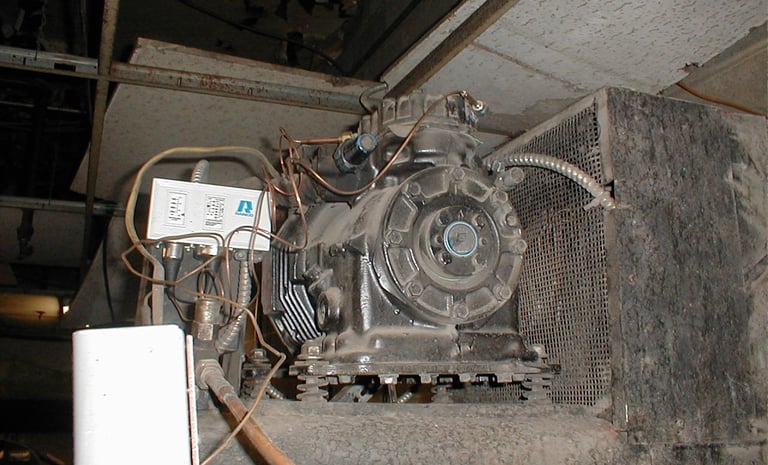
Knowing how compressors and evaporators are selected may help to solve this problem.
Compressors are selected based on their rated capacity — in BTUs per hour — using a specific refrigerant at a target evaporating temperature. These design criteria were originally specified by the original sales engineer or installing contractor, once a heat load calculation was done for the product to be cooled.
The original sales engineer or installing contractor also decided on the type of the evaporator to use for this particular application. The evaporator selected must match the rated capacity of the compressor in order to have a properly operating system.
For our problem, if the capacity of the evaporator were known, we would be able to determine the BTU capacity of the compressor. By looking at the data plate of the evaporator we should be able to determine its BTU capacity needed at its designed delta T.
The delta T is the temperature difference between the evaporator temperature and the box temperature. The delta T is usually designed at 10ºF or 15ºF. By calling your local supply house or the manufacturer of the evaporator, you should be able to find the rated capacity of the evaporator, which would then be the capacity of the compressor needed.
Once the BTU capacity is known, the evaporator temperature must be determined. This is usually determined by subtracting the delta T from the coldest box temperature to be achieved.
For our example, the coldest box temperature desired would be 35ºF. That would make our evaporating temperature between 20ºF to 25ºF.
Next, we need to determine the type of refrigerant used in the system. Again since the compressor data plate is missing or non-readable, we must find another way to determine which refrigerant was originally used in the system.
There are two ways to find this out. The first way is to look at the thermostatic expansion valve. The TXV model number should tell you the type of refrigerant it was designed for.
The second way is to do a standing pressure test at the condenser or receiver. If there is a saturated refrigerant in either of these components, the type of refrigerant in the system can be discovered by comparing the ambient temperature surrounding these components to the pressure reading on your gauges.
Additional information is also required to select the right compressor.
Its supply voltage and electrical characteristics must be known. This can be determined simply by measuring the supplied voltage at the defective compressor and seeing which starting and running components are used. If the original compressor uses a start or run capacitor, it is usually better to replace it with a compressor that uses the same type of components.
Now that the BTU capacity of the compressor, the evaporating temperature, the refrigerant used and the electrical characteristics are known, the right compressor can be selected for the job.