
Using a Low Pressure Control for Temperature Control
The use of a low pressure control to maintain box temperature on commercial medium temperature applications has been a common practice for many years. It allows remote condensing units to be controlled without any additional control wiring between the refrigerated box and its compressor. It works on the principle that there is a direct relationship between the pressure of the saturated refrigerant in the evaporator and its temperature. For every pressure of a saturated refrigerant, there is an associated temperature. A typical low pressure control has two setpoints, its cut-in and its differential. In order for the control to work properly, both the cut-in and differential setpoints need to be set properly. Most manufacturers have stated values for the proper setpoints for their systems; however, these stated values usually work well on self-contained or close coupled systems. If the condensing unit is remotely located their stated values may cause problems with the cooler.
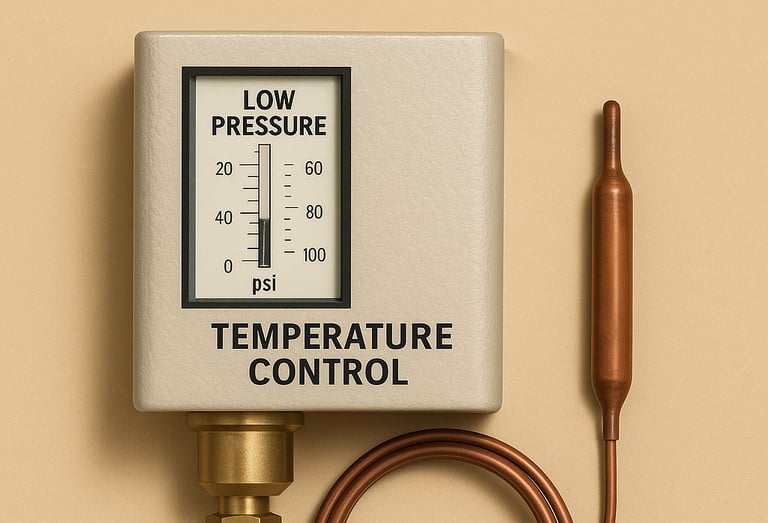
On systems where the condensing unit is located a considerable distance away from the evaporator, it is more accurate to first set the cut-in setpoint. The cut-in setpoint should be set to a pressure (temperature) that will allow the evaporator to completely defrost during the off cycle. Since most commercial refrigeration systems work with a coil temperature below 32°F (usually between 20°F and 25°F) frost will develop on its coils. If this frost is not removed and continues to form, it will eventually completely block the airflow through the evaporator coil and cause the unit to malfunction.
The cut‑in value needs to be set to a pressure (temperature) that will not allow the compressor to come on until the coil is completely defrosted. Typically if the coil temperature is above 33°F no frost should be on the coil; however, that is usually too close for comfort. Most system designers recommend that the coil rise to a temperature between at least 36° - 39°F before allowing the compressor to cycle on. This will ensure that the coil has been completely defrosted.
Once the cut-in pressure has been set, the differential setting must then be set. The differential setting is used to cycle the compressor off at the lowest possible box temperature. The differential setting represents the difference between the cut-in pressure and the cut-out pressure. For example if the cut-in pressure is set at 40 psig and you want the compressor to cycle off at 15 psig, the differential setting would need to be set at 25 psig ( 40 psig -15 psig = 25 psig ). The exact cut-out pressure needed to correctly cycle off the compressor may be different from unit to unit. One of the reasons for this is that the pressure drop from the evaporator to the compressor may be different on each unit. Here’s an easy way to correctly set the differential pressure:
First set it to an extremely high value (a value the suction pressure should never reach under normal operating conditions—30 psig should suffice).
Allow the system to run while monitoring the box temperature.
Once the box reaches its lowest desirable temperature, slowly adjust the differential counter-clockwise until the compressor cycles off.
Using this procedure will ensure the cut-in and differential setting have been properly set and the system will function properly.